
It’s been about 3 months now since the spring water dam works began in early Sep 2019. Thankfully, the raw foundation works were completed just in time for the dam to stand the test of time and the onslaught of the rainy season. This test is required to see how well the dam withstand the force and high volume of water. Withstood it did! But not without some ongoing improvements and necessary upkeep.
Understandably a sustainable and environmentally friendly dam of this nature requires regular maintenance. Without a worker, that’s difficult. But the looming dry season has reignited the need to quickly look into its completion after a 3 month halting of works due to other pressing matters at the farm. Only once the dam is completed, can the piping be laid. The piping is sorely needed for drip irrigation works.

A visit to the dam for check-up today necessitated a quick fix to the front wall with more sand bags. Incessant rain has filled up the main dam and Filter 3 to the brim with silt, while Filter 1 and 2 are clogged up with debris and sand. The design performed as intended. However, I have to admit I underestimated the force of water. Some earth was removed from the dam’s vicinity to seal up the dam wall, resulting in some erosion around the dam. This can be fixed by planting more vetiver but the establishment of this super grass will take at least 1 year.
There is also an additional consideration to be taken with regards to the run off streaming down the surrounding steep slopes leading to the dam. These run off bring with it immense amount of silt. Hence, the planting of vegetation to hold back silt and slow water movement has to begin from a little uphill as well. That’s a huge undertaking to be done in stages over time.


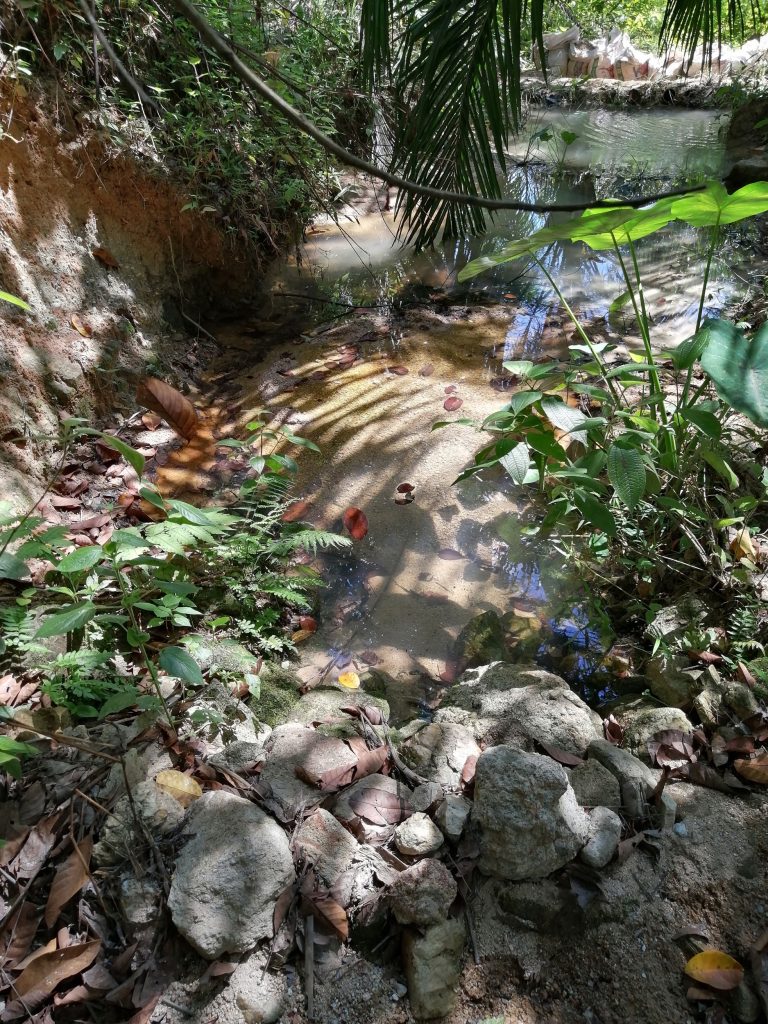
Pretty good quality sand can be easily mined and removed from Filter 1 and 2 as part of regular maintenance works. Unfortunately, silt (the more difficult material to work with) has to be periodically and manually removed as well from Filter 3 and the main dam, but I got to leave that to workers in the future. As for now, I would need to strengthen all barrier walls, remove some sand and plant more vetiver on the banks. This would be a series of ongoing maintenance and enhancement process over a period of time.
The next immediate thing to do now is to build an experimental bigger filter to block out silt from entering the intake pipe. I would update in a future post once that is completed. Only after the filter is done and installed, can the piping be laid.