
It’s been a little over 2 months since I started erecting/planting the live fence by the road to generate fodder materials for goats. Some of the moringas have taken root and sprouted while some seemed to be still struggling. Others are pretty much dead. The leucaenas are doing fine. Some napier took off while most died. The soil is pretty hard and some sections don’t look fertile. I will have to wait a little while longer before pulling out the dead ones and replant with new cuttings/grasses.

In the mean time, I’m continuing the line of live fence with a fresh batch of gliricidia sepium cuttings I obtained from a friend’s farm. I’ve also extended the napier grass line by planting a couple more clumps by the road shoulder. These fodder material when matured and ready for harvest would be easily obtained and loaded to the truck as I drive along this stretch.

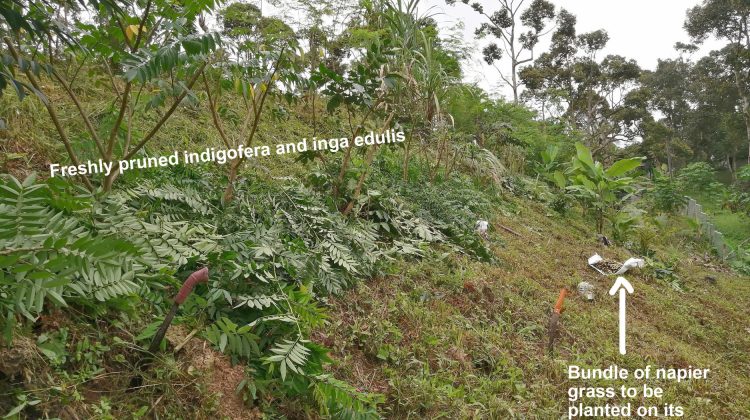
Down hill from the narrow strip of flat land where the live fence is, I’ve began to implement an agroforestry system of planting. Right after the live fence line, I implemented a row of inga edulis (ice cream bean) trees. Right after this further down hill, I’ve planted a row of coconut trees. The concept is pretty simple. The fast growing leguminous inga edulis would help build soil by increasing organic material content through the occasional chop-and-drop approach of creating mulch. This mulch would benefit the fodder live fence above it and the coconuts right below it. The “main crop” here would be coconuts, but they can be any other types. Hence, the soil builder element (inga edulis) is sandwiched between the rows of high value crops. I may choose to implement more lines in the future by inter-cropping but this will do for now.


As mentioned earlier, this strip of extremely steep land is in fact a reserved road that is not officially part of the farm. However, since it’s adjacent to the farm, I’m putting it to good use by planting fodder vegetation for livestock. I’m also trying to squeeze in some main crops (coconuts, kaffir lime, mulberries, etc) – that are not too valuable lest they could be target for trespassers and thieves – just to maximise the use of the land.
I reckon coconuts take time to grow and their fruits would be difficult to harvest (the saplings I got it for free too). Kaffir lime fruits are not much in demand apart from the leaves but that’s manageable. Mulberries would be quite a hassle to harvest in large quantities, hence, the choice of so called “main crops” selected here. There could be others such as pandan leaves, torch ginger or timber trees to be planted that I wouldn’t be too worried if theft occurs. Planting seemingly non-valuable crops like fodder for livestock is the most sensible thing to do on land that we may not have official ownership to.
As for the concern of fertility along the live fence line, I would have to resort to using some application of chicken dung or other manure to get the fence established. Hopefully this is required only for the initial phase of planting. Perhaps when rainy season comes this year end, the fence would be more firmly established. Until then, a little manure should go a long way to ensuring they take root.