
The implementation of syntropic agroforestry is often much discussed and assumed in the context of a nice piece of flat land where you can make endless rows of planting that grow in succession. In theory, it’s heavenly. What happens if you’re crunched for space and you only have a small strip of 4-6 feet of flat land before it plunges into a drop of 20-30 feet of land at a 45-degree angle? The textbook goes out the window!
In the photo seen above, there’s a 150m drive-along mart of fodder to be cut and carried onto the truck back to farm. Hence, the siting of live fence and grasses to facilitate harvest and transport by the road. Chop/drop on road shoulder is to be done for decomposition and resulting nutrients to “trickle” down the slope. Entrance to the farm’s 2-acres is seen on the right (far end down the road) where the GI fencing structure is seen. The slope to the left down hill remains a formidable challenge.
Add to that the fact that it’s a reserved land buffered away in this development where the farm is located; one is pretty much left with options that only serve the law of impermanence. Since it’s adjacent to the farm’s 2-acre, I’ve “assumed stewardship” of this rather large area to be designated as my “Zone 5”. This area has undergone little but increasing change since the agroforestry live fence was setup almost a year ago.


So how do you implement syntropic agroforestry on a land that you do not own, but with very much high probability it will be untouched for an indefinite period of time; whilst maximizing its usage in a regenerative way that wildlife will thank you? You plant support/fodder plants that generate huge amount of biomass while they support target plants of questionable value. “Questionable” being that they are of no immediate value to the uninitiated (Gelam, Keruing, Meranti, Kapok, Coconut, Jackfruit, etc) that even if this piece of land were to be mowed down, my losses are almost non-existent monetarily.
Hence, my going with the live fence approach and cheap edibles such as coconut and jackfruit. Coconut takes time to grow and their fruits may not be that accessible (tall kampung varieties). People will think twice before attempting to “steal”. Jackfruit is common enough and they fruit all year; more importantly, their leaf serves as good feedstock for ruminants. Understandably, I can’t grow durians at this plot, not at least the good variety that I have to spend money to buy.
In essence, the entire area (in order of my immediate needs):
1. Supplies me with animal fodder.
2. Serves as a secondary/backup food store of edibles for humans (berries, herbs, tubers, etc) in support of those already growing inside the farm’s 2-acres.
3. Generates biomass materials for building (timber), fertility resource (biochar) and utilities (firewood).
4. Supports wildlife (birds/squirrels nesting on big tall dipterocarps) and pollinators (feeding on flowering trees/shrubs).
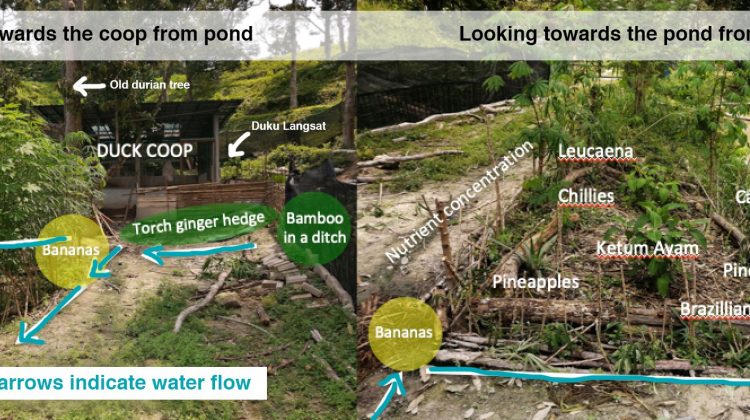
Meanwhile, a similar concept is also being implemented in another “premium space” at the farm. Here’s a look at how I’m attempting to implement some concepts of agroforestry on one of many difficult but prime locations at the farm; “prime” because of sunlight coverage. It’s still very much work in progress as I’ve yet to complete planting target trees and supporting species.
Theory dictates the simultaneous planting of target and support species but it doesn’t tell you that that works if you have a village of people to chip in. So, I’m going at my comfortable pace and will try to capitalize on the coming rainy season.


Here, one can also see the progression flow of “energies” from left to right by the placement of capture systems; first by the ditch, followed by a banana cirlce and eventually the future pond at the lowest part. FYI, the area by the pond and the road shoulders of the main road to the farm have the most fertile blackish soil at the farm (some of which I harvest to sell).